Let’s Connect!
Work can be a fun when we know and understand each other well. Let's start conversation to new beginning

+91 63542 35108
To discuss what we can do for you Give us a Call

connect@ashutec.com
Tell us about your next project Write to us

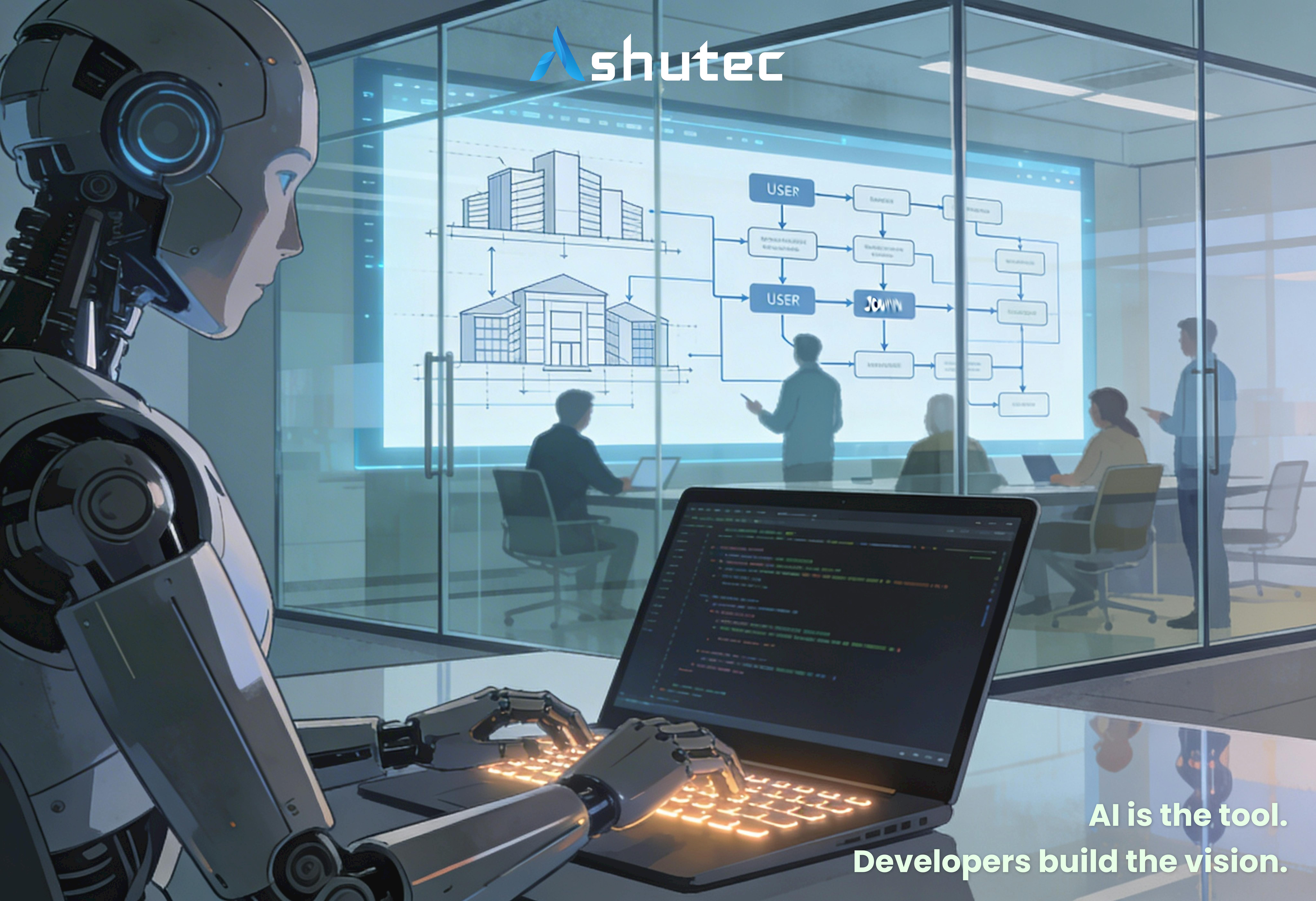
Over the past year, many business leaders have started experimenting with AI tools that generate software. With a few prompts, a working interface appears — dashboards, portals, admin panels, and internal tools can now be produced surprisingly quickly.
That leads to a reasonable conclusion:
If software can be generated, why involve a development company at all?
The answer appears only when the software becomes part of daily operations.
Companies are not looking for software itself.
They are relying on systems that run their daily operations.
AI is effective at producing functional components. It can create forms, user accounts, panels, APIs, and databases. In isolation, these often work well.
But business applications are not individual components.
They are operational chains.
A client submits data. A workflow triggers approvals. Records update. Notifications send. Billing is generated. A payment is processed. Reports update. Management reviews analytics. Support accesses history.
The application is not the interface employees see.
The application is the reliability of the entire process.
When any step fails, the business process fails.
AI can create working screens.
It does not design business operations.
A service company recently introduced an internal management system created using AI-generated tooling. The system allowed staff to register clients, assign work, and generate invoices.
Initially, everything appeared successful.
After several weeks, inconsistencies appeared. Some invoices were generated without associated service records. Certain client updates did not reflect in reports. Payment confirmations occasionally failed to update account balances. Management reports showed revenue numbers that did not match accounting entries.
The system was functioning technically.
Operationally, it was unreliable.
Employees began keeping parallel spreadsheets to verify data. Staff double-checked invoices before sending them. Management no longer trusted automated reports.
The business had software, but it could not depend on it.
The core issue was architectural. Data relationships, transaction handling, validation logic, and reconciliation processes had never been designed as a unified system. The application existed, but the business workflow did not.
Fixing it required restructuring database models, implementing transaction safety, handling edge cases, integrating accounting properly, and creating monitoring mechanisms.
The real work began after the software was already built.
Building internally with AI often feels efficient because progress is visible quickly.
Risk appears later.
When an operational platform becomes unreliable, companies start compensating manually. Staff verify records, cross-check reports, and handle avoidable support issues. Decision-making slows because leadership does not trust system data. Growth becomes difficult because processes cannot scale reliably.
The cost is not development.
The cost is uncertain.
Businesses depend on accurate records, correct billing, and predictable workflows. When software becomes questionable, the organization itself becomes inefficient.
A professional development partner does not primarily sell programming.
The value is system design.
Before development, workflows are mapped, edge cases anticipated, data relationships defined, and integrations planned. Payment handling, reporting accuracy, user permissions, and failure recovery are designed intentionally. The system is built so operations continue even when unexpected conditions occur.
There is also accountability. When a critical process stops, someone understands the architecture and resolves the issue.
AI generates functionality.
A development partner builds reliability.
AI is not replacing development companies. It is changing their tools.
Experienced teams already use AI to accelerate implementation, automate repetitive work, and improve testing. It speeds up coding. It does not replace architectural decisions, operational logic, deployment planning, monitoring, or long-term maintenance.
AI improves construction speed.
It does not replace engineering responsibility.
When organizations work with a development partner, they are not paying for software creation alone.
They are reducing operational risk.
They gain structured workflows, dependable integrations, scalable infrastructure, accurate reporting, and support when systems are critical to daily activity. More importantly, they gain confidence that their processes will continue to function as the company grows.
Modern businesses increasingly operate on software platforms — internal systems, client portals, workflow automation, and data processing.
The important question is no longer whether software can be produced.
The real question is whether the organization can rely on it.
AI can generate an application.
A dependable business system still requires experienced engineering behind it.