Let’s Connect!
Work can be a fun when we know and understand each other well. Let's start conversation to new beginning

+91 63542 35108
To discuss what we can do for you Give us a Call

connect@ashutec.com
Tell us about your next project Write to us

If you search for how software development works, you will find endless explanations about programming languages, frameworks, and methodologies. Almost none of that helps when you are a founder trying to turn an idea into a real product for the first time.
The difficulty most founders experience is not technical. It is interpretational. The challenge is translating a business idea into precise software behavior. Most first products do not fail because the idea was weak or the team was incapable. They fail because small misunderstandings occur early and quietly compound over time.
At first, everything appears manageable. A missing detail here, a minor assumption there, and everyone believes it can be adjusted later. But software becomes harder to change as it grows. By the time a founder realizes the product does not match what they imagined, changing direction feels expensive, slow, and emotionally exhausting. We have repeatedly seen this pattern across early-stage startups, especially when the founder does not come from an engineering background.
This article exists to explain where things actually go wrong and how to prevent it before development even begins.
Many founders believe development will naturally create clarity. In practice, development exposes the absence of clarity.
Software engineers do not build ideas or intentions. They build defined behavior. A founder usually carries a clear mental picture of how the product should feel and how simple the experience should be. However, software cannot be constructed from a feeling. It requires instructions that describe exactly what happens at each step.
A founder may say users should easily book a session. A developer must then determine what happens if two people try to book the same time, whether cancellations are allowed, how refunds work, how availability updates, and what occurs when a payment fails. When those decisions are not specified, developers must fill the gaps with assumptions, and those assumptions rarely match the founder’s expectations.
This is not a communication failure. It is a structural difference between vision and executable logic. Development does not remove that gap. It reveals it.
Nearly every first-time founder believes their MVP is small. From a business perspective, that is understandable. From a system perspective, it is rarely true.
At the start, the product appears straightforward. It may only include users, bookings, or transactions. Once actual screens and workflows begin to exist, hidden decisions surface. Questions about mistakes, permissions, editing, notifications, and administrative controls appear. None of these questions are unreasonable. Each one feels necessary. Together they significantly increase the size of the system.
From the founder’s point of view, the product is becoming complete. From the development team’s perspective, the target keeps moving. This is why timelines extend without anyone deliberately causing delay. The product did not slow down because development was inefficient. It slowed because the scope was still being discovered during the build.
A predictable tension appears in almost every first product. Founders expect speed because the idea feels clear in their mind. Developers need clarity because speed depends on finalized decisions.
When a founder describes a change as small, they are describing intent. When a developer estimates additional time, they are considering consequences across logic, data handling, testing, and existing functionality. Both viewpoints are valid, yet they operate on different layers of the same system.
Pressure rarely accelerates development. Clear decisions do. Without shared understanding, frustration builds on both sides even though neither side is acting irrationally.
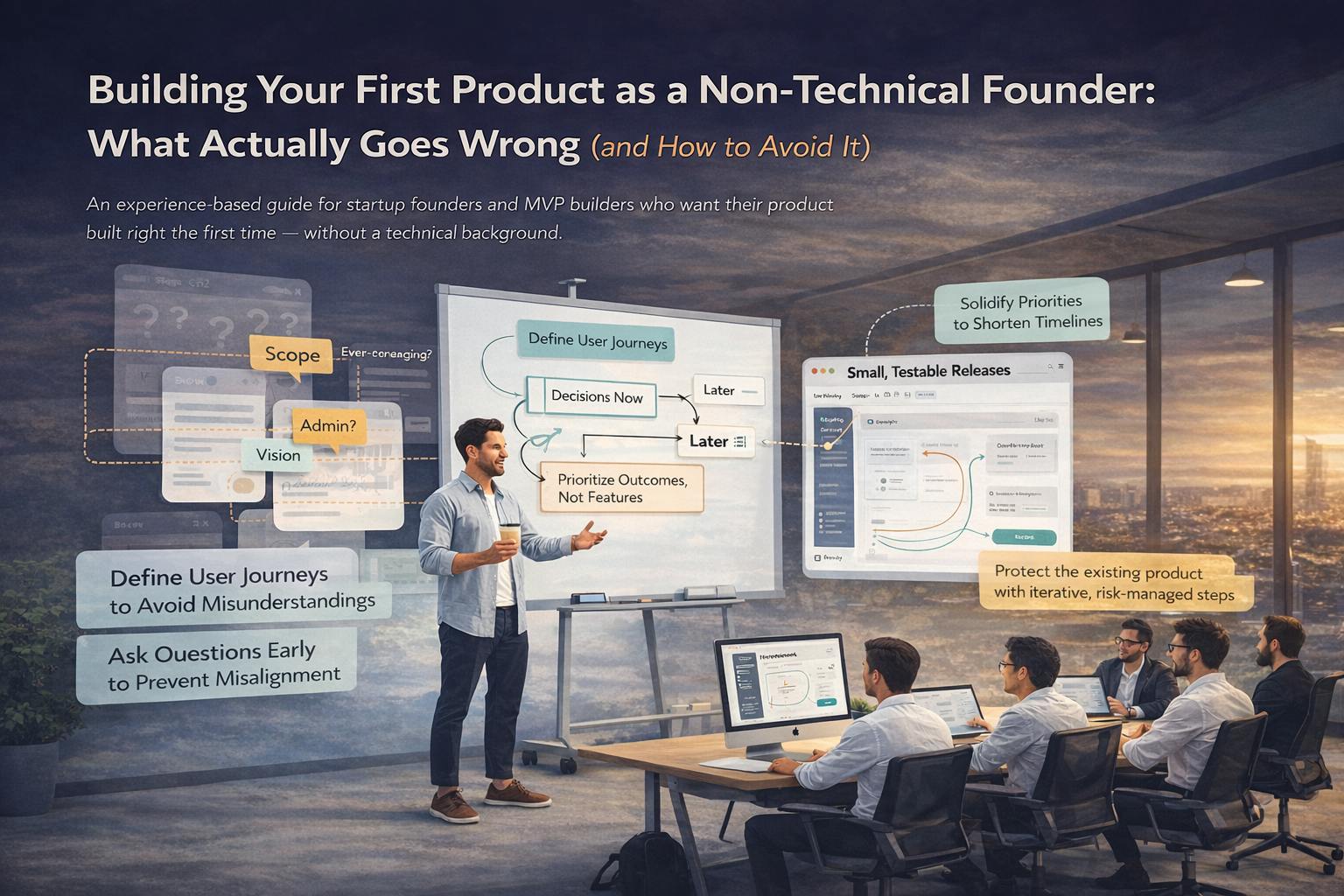
The first step in building a product is not selecting a technology stack, hiring developers, or even beginning design work. The real starting point is the ability to describe one complete user journey from beginning to end.
A founder should be able to explain what a user does first, what they see next, how they complete their goal, what success looks like, and what happens when something goes wrong. If that journey cannot be described clearly, development will eventually uncover the gaps at a stage when changes are expensive.
Clarity before code is not preparation. It is protection. It preserves time, budget, and momentum later in the project.
One of the most common mistakes founders make when selecting a development partner is choosing the team that feels most comfortable. Teams that agree quickly, avoid difficult questions, and promise immediate speed create reassurance at the beginning. Unfortunately, they often deliver software that functions technically but does not match expectations.
Strong partners behave differently. They ask difficult questions early, challenge unclear ideas, and discuss trade-offs openly. They sometimes recommend postponing features that increase risk. This friction early in the relationship is not resistance. It is alignment.
If a partner never slows you down at the beginning, the project will slow down later when correcting misunderstandings becomes harder.
A founder does not need technical knowledge to build a successful product, but the founder must reduce ambiguity. It is reasonable to expect visibility into progress, incremental working releases, and honest feedback when risks appear. It is not reasonable to expect every change to be instant, inexpensive, or reversible.
Software behaves as a connected system. Decisions affect other parts of the product. Indecision introduces more cost than almost any feature.
Many founders communicate through features because features feel concrete. They request screens, automation, or artificial intelligence integrations. Developers interpret these as tasks rather than goals.
A more effective approach is describing the problem being solved, who it is for, and how success will be measured. When developers understand the intended outcome, they can make correct implementation decisions even when details evolve. This significantly reduces rework and misunderstanding.
Experienced teams assume some decisions will inevitably be wrong because real users behave unpredictably. Instead of attempting to avoid this, they structure the process to discover mistakes early.
They release small working sections, test real usage quickly, protect stable workflows, and avoid large all-at-once launches. Showing working flows early allows misalignment to appear while changes are still inexpensive. Products succeed not because the initial plan was perfect, but because corrections were possible early.
Non-technical founders often do not need more technical information. They need structure and guidance. ashutec works with founders building their first serious product and focuses on preventing the common issues that lead to rebuilds, delays, and unexpected costs.
The goal is not only to write code but to structure the build so decisions happen early, risks become visible quickly, and the product can grow without constant rework. This results in predictable timelines and software that supports the business rather than continuously demanding correction.
Your first product will change. That is part of building a real company. What should not change is the foundation supporting it.
When clarity comes before development, progress becomes faster. When decisions are deliberate, costs become predictable. When partners challenge assumptions early, outcomes improve. This is the difference between a product that launches and a product that stalls.