Let’s Connect!
Work can be a fun when we know and understand each other well. Let's start conversation to new beginning

+91 63542 35108
To discuss what we can do for you Give us a Call

connect@ashutec.com
Tell us about your next project Write to us

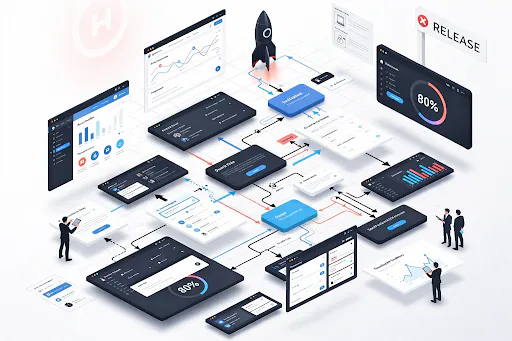
Legacy systems rarely break all at once. They slow things down gradually.
What starts as a minor delay in releasing features eventually turns into missed opportunities, frustrated teams, and growing technical limitations. Businesses often don’t realize the impact until their system becomes more of a burden than a strength.
For many companies, the software that once supported growth is now standing in its way.
In 2026, however, this challenge is being approached differently. Instead of choosing between maintaining outdated systems or rebuilding everything from scratch, businesses are turning to AI-powered modernization to evolve what they already have.
Legacy system modernization is no longer about tearing everything down and starting over.
It’s about transforming existing systems into something faster, scalable, and adaptable without disrupting business operations. Companies are now focusing on improving what works while fixing what doesn’t.
This shift has made modernization far more practical. Instead of long, expensive rebuild cycles, businesses can now upgrade their systems in a more controlled and efficient way.
Outdated systems don’t just affect technology; they impact the entire business.
When development teams spend more time fixing issues than building new features, innovation slows down. When integrations become difficult, growth becomes limited. When performance suffers, user experience follows.
Over time, these challenges build up into technical debt that becomes increasingly expensive to manage. The longer it is ignored, the harder it becomes to fix.
Artificial intelligence is transforming how businesses approach modernization.
Instead of relying on manual audits, AI can quickly analyze large codebases and identify inefficiencies, risks, and opportunities for improvement. This allows teams to make faster and more informed decisions.
Refactoring, which once required extensive effort, is now more efficient with AI-assisted development. Existing systems can be improved step by step without losing their core functionality.
Even cloud migration, which used to feel complex and risky, has become more streamlined. AI helps map dependencies and reduce the chances of disruption, making the transition smoother.
Integration has also become easier. Modern businesses rely on connected systems, and AI simplifies the process of building and managing APIs, allowing platforms to work together more seamlessly.
What’s changing most is not just the technology, but the mindset around it.
Businesses are no longer postponing modernization because of cost or complexity. They are recognizing that staying on outdated systems is often more expensive in the long run.
Companies that move faster, adapt quicker, and scale efficiently are gaining a clear advantage. Modernization is becoming a strategic decision rather than a technical one.
At ashutec solutions, modernization is approached with a focus on real business outcomes, not just technical upgrades.
We’ve worked with companies that felt stuck with slow, difficult-to-maintain systems. Instead of recommending complete rebuilds, we helped them identify what could be improved and what could be retained. By introducing AI-assisted development and modern architecture practices, these businesses were able to significantly improve performance and scalability without unnecessary disruption.
In one case, a company struggling with frequent system issues and slow feature releases needed a better way forward. By gradually modernizing their platform and optimizing their existing codebase, we helped them reduce development time and deliver a much smoother user experience.
In another instance, a growing business needed better integrations to support its expansion. By restructuring their system and implementing scalable APIs, we enabled them to connect tools effortlessly and operate more efficiently.
These experiences highlight an important reality. Modernization is not about starting over. It’s about moving forward in a smarter, more sustainable way.
There usually comes a point when maintaining an existing system becomes more difficult than improving it.
If your team is constantly dealing with bugs, struggling to add new features, or facing limitations in scaling your product, it’s a strong indication that your system needs attention.
Recognizing this early can save significant time, cost, and effort in the long run.
Modernization today is about taking a balanced approach.
Instead of making drastic changes all at once, businesses are choosing to evolve their systems step by step. This allows them to see immediate improvements while reducing risk.
With AI playing a supporting role, this process has become faster, more accurate, and far more efficient than traditional methods.
Legacy systems are not necessarily the problem. The real challenge is staying stuck with them.
The businesses that are succeeding today are not the ones rebuilding everything from scratch. They are the ones making smarter decisions about how to improve what they already have.
With the right strategy and the right partner, modernization becomes less about disruption and more about progress.
In 2026, the advantage belongs to companies that choose to modernize intelligently and move forward with confidence.