Let’s Connect!
Work can be a fun when we know and understand each other well. Let's start conversation to new beginning

+91 63542 35108
To discuss what we can do for you Give us a Call

connect@ashutec.com
Tell us about your next project Write to us


This article comes from real project experience working with early-stage startups and MVP founders.
Many founders assume software projects fail because development is difficult.
That’s rarely the real reason.
Most difficult projects actually go wrong before the first line of code is written — at the moment a founder chooses a development company and unknowingly commits to a particular way of building the product.
At the beginning everything feels straightforward. You explain the idea, the company understands it, they send a proposal, and development begins. The early weeks feel productive because visible progress appears quickly. Screens are shared. Demos happen. It looks like the product is moving forward exactly as planned.
The tension usually doesn’t appear immediately.
It shows up a few months later.
A founder asks for a change that feels small from a business perspective — a workflow adjustment, a different approval step, or a slightly altered user journey. Instead of a quick update, the team explains that the change affects multiple parts of the system. The estimate grows. The timeline shifts. The product suddenly feels less flexible than expected.
This is often interpreted as a development problem.
In most cases, it is a decision-making problem.
When you hire a development company, you are not only choosing who will build the first version of your product. You are choosing how easily your product can change in the future.
Software is not just screens and features. Underneath every interface is structure — data relationships, workflows, permissions, and system rules. Those are determined early, often during conversations founders consider “preparation.”
Early discussions about how users sign up, how actions are approved, or how information is stored may feel minor. They are not. These decisions define whether the product grows smoothly or becomes fragile.
The difficulty is that a first-time founder usually evaluates companies using visible signals: portfolio, price, speed of proposal, and communication style. Those matter, but they do not show how the team handles uncertainty. And early-stage products are mostly uncertainty.
A development team can accurately build what you describe and still leave you with a system that becomes expensive to evolve. Not because they did something wrong, but because the initial assumptions were never challenged.
Fast starts feel reassuring. A team that quickly accepts requirements and begins implementation appears efficient.
But speed early in a product build often comes from skipping clarification.
In the first version of any product, the biggest unknown is not the technology. It is user behavior. Once real users interact with the product, you will learn things you could not predict beforehand. Flows will need adjustment. Features will change priority. Some ideas will matter less than expected and others more.
If the product structure was created without anticipating change, every new learning becomes a technical problem instead of a product improvement.
This is why some startups continue improving after launch while others spend months modifying what already exists.
Many founders treat the first release as a smaller version of the final product. They try to include every feature they imagine users might need so they won’t have to rebuild later.
The opposite is usually true.
A first version is meant to answer questions, not finalize the business. Its purpose is to confirm that the core workflow works in real usage. When too much is included early, complexity grows before understanding does.
An experienced team will often reduce scope at the beginning. That can feel counterintuitive, especially when a founder wants to launch quickly with a complete offering. But reducing scope early protects flexibility later. It allows the product to adapt based on actual behavior instead of predictions.
Projects become difficult not when development is slow, but when learning requires restructuring.
Comparing development companies through proposals and timelines seems logical. Yet proposals mainly describe output, not process.
A proposal can outline features clearly and still leave major decisions undefined. It does not show how the team reacts when assumptions change, when priorities shift, or when new information appears after users interact with the product.
Software development is less like construction and more like navigation. You are moving toward a destination while discovering terrain along the way. What matters is not only who can build, but who can adjust direction without losing stability.
Teams that spend more time clarifying workflows and edge cases before coding are not delaying progress. They are reducing the amount of rework required later.
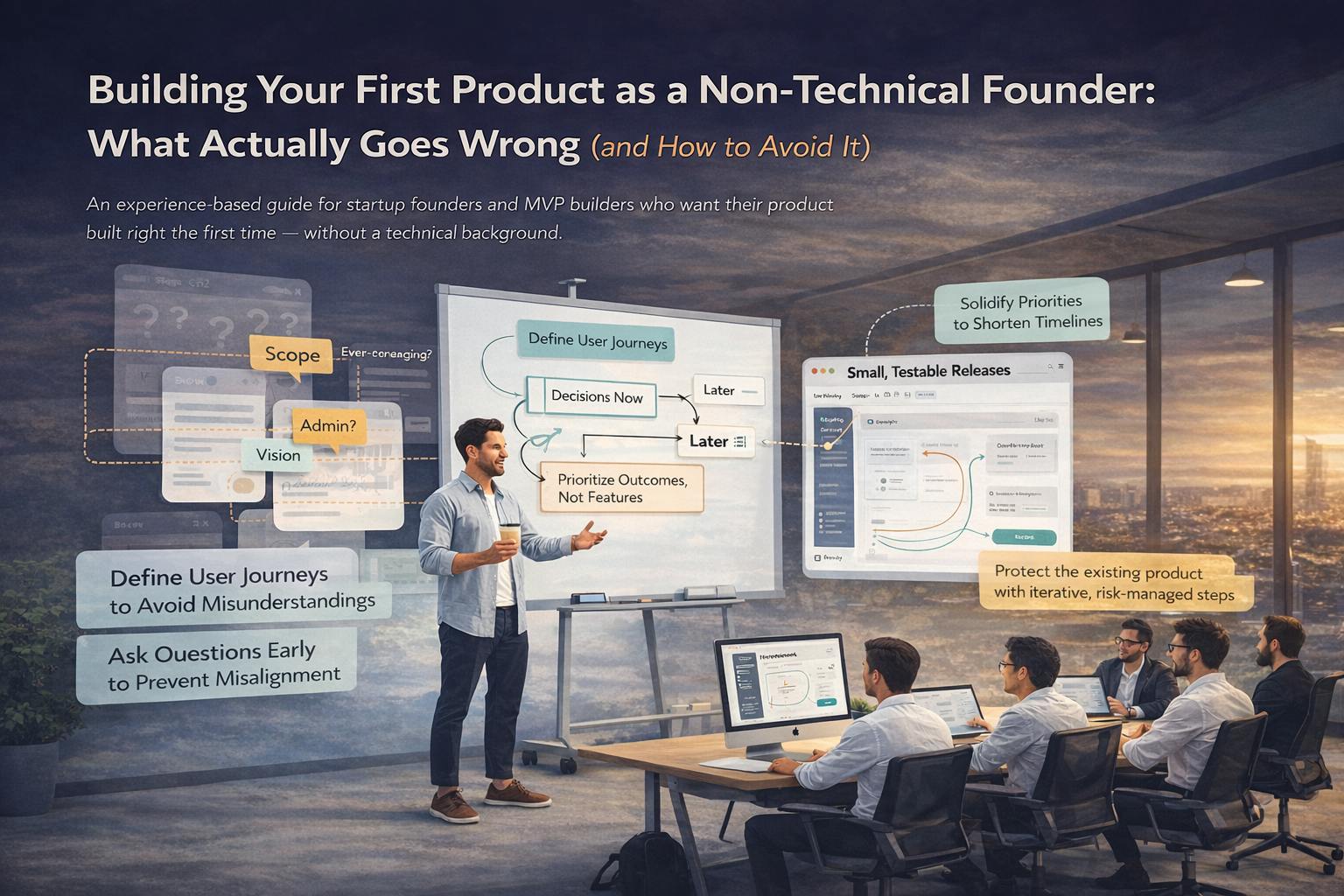
Before committing to development, you should leave early conversations understanding what the first version is meant to prove. You should know how feedback after testing will affect the roadmap, how frequently you will see working software, and how changes will be evaluated.
You should also understand who is helping translate business ideas into technical decisions. In many startup projects, the founder unknowingly carries that responsibility. Without guidance, decisions get made reactively during development, when they are most expensive to change.
Clear expectations early do not eliminate iteration. They make iteration manageable.
Before signing a contract, a founder should be able to clearly understand how the team approaches change, feedback, and product decisions. Useful early conversations are not only about features, but about how uncertainty will be handled during the build.
How will you help define the first version of the product?
How often will I see working software?
What happens when requirements change after development starts?
Who translates business workflows into technical structure?
How do you prevent the need for major rebuilds later?
How will post-launch improvements be handled?
We created this guide after speaking with many founders who came to us only after development had already started elsewhere — often when timelines slipped, features became difficult to change, or the product felt harder to grow than expected.
In most cases, the problem wasn’t effort or talent.
It was that important product decisions had been made too late, or without enough technical context early on.
At ashutec, our involvement usually begins before coding. We help founders shape the first version of the product so it can evolve safely after launch — not just get released.
If you’re planning to build a SaaS platform, an AI application, or an MVP and want a second opinion before committing to development, you can share your idea with us. Even a short early conversation often clarifies scope, timeline expectations, and technical approach in a way that prevents expensive rework later.
No preparation or technical knowledge is needed — just a clear description of what you’re trying to achieve